
Fat dissolving injections have become one of the more searched aesthetic treatments in the last few years, driven partly by social media and partly by the genuine appeal of a non-surgical option for stubborn fat. If you’ve been curious but skeptical, that’s a reasonable position. This post gives you the honest explanation of what these injections actually are, how the science works, what results are realistic, and what the experience looks like from first appointment to final outcome.
If you’re already familiar with the basics and want to find out whether Kybella makes sense for you specifically, our Kybella service page covers candidacy, the treatment process at FACE/FIT, and what to expect in detail.
What Fat Dissolving Injections Actually Are
The active ingredient in FDA-approved fat dissolving injections is deoxycholic acid, a molecule your body already produces naturally. In your digestive system, deoxycholic acid helps break down dietary fat for absorption. When it’s injected directly into a fat deposit, it does the same thing to the fat cells there: it disrupts the cell membrane, causing the cell to break down and release its contents. Your body then clears the cellular debris through the lymphatic system over the following weeks.
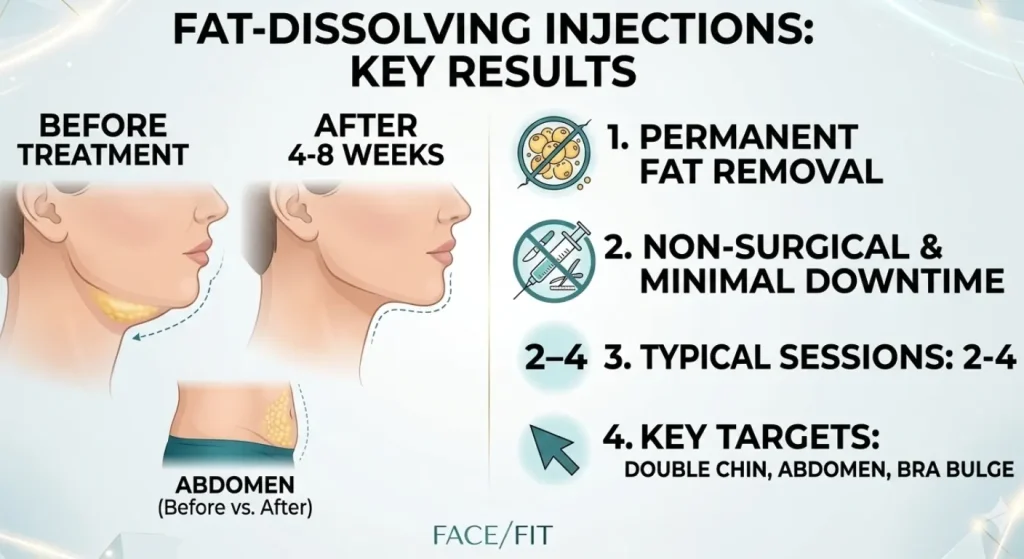
The key word in that explanation is permanent. Once a fat cell is destroyed by deoxycholic acid, it doesn’t regenerate. The cells that are eliminated are gone. This is meaningfully different from treatments that simply shrink fat cells temporarily, and it’s why the results of a completed treatment course are lasting rather than requiring indefinite maintenance.
FDA clinical trial data for deoxycholic acid showed that over 68 percent of patients responded with visible fat reduction, with MRI scans confirming a significant decrease in fat volume following the treatment series. These aren’t subtle findings on selected patients — they’re the numbers that got the treatment approved.
According to FDA clinical trial data for deoxycholic acid (the active ingredient in fat-dissolving injections) reveal that over 68% of patients responded with a visible reduction in fat, while MRI scans confirmed a significant decrease in fat volume following the treatment series.
What It Can and Can't Do
This is the part that matters most for setting realistic expectations, and it’s where a lot of the skepticism about fat dissolving injections comes from. People see dramatic before/after photos online and assume the treatment works everywhere on the body at any scale. It doesn’t, and understanding the limits is what separates a patient who’s genuinely happy with their results from one who isn’t.
Fat dissolving injections work best on small, defined fat deposits. The submental area (under the chin) is the only FDA-approved indication for Kybella, and it’s also the area where the treatment produces the most consistent results. The geometry works: the fat deposit is localized, well-defined, and accessible. The treatment can eliminate it with precision.
Larger fat deposits on the abdomen, thighs, or flanks can be treated off-label, but the results are more modest. Fat dissolving injections are not a substitute for liposuction or a GLP-1 weight loss program when it comes to larger-scale body contouring. They’re a precision tool for isolated deposits, not a wholesale fat reduction method.
They also don’t address skin laxity. If loose or crepey skin in the treatment area is part of the concern, fat removal alone can sometimes make skin looseness more visible. Patients with both fat and skin concerns in the same area often benefit from pairing Kybella with a skin tightening treatment like Attiva RF, sequenced appropriately.
The Treatment Process
Understanding what actually happens across a treatment course makes it easier to plan around and easier to stay patient through the parts that require patience.
Session one: Your provider maps the treatment area, marks injection points, and applies numbing. Multiple small injections are placed across the area. The session itself takes 15 to 20 minutes. Deoxycholic acid begins working immediately on contact with the fat cells.
The days that follow: This is the part that surprises patients who aren’t prepared for it. Significant swelling in the treatment area is normal and expected, sometimes described as “frog neck” when the chin area is treated. Swelling peaks around days two through four and can look dramatically worse than before treatment. This is the inflammatory response that’s part of how the treatment works. It’s temporary. It is not your result, and patients who know this in advance handle it significantly better than those who don’t.
Numbness, bruising, and firmness in the area are also common and resolve over several weeks as the body clears the treated cells.
Four to eight weeks later: This is when results begin to become visible as the lymphatic system finishes clearing the broken-down cells. The process isn’t immediate because biological clearance takes time.
How many sessions: Most patients need two to three sessions spaced at least four to six weeks apart. Some patients with mild submental fullness see sufficient improvement from a single session. Some with more established deposits benefit from a third. The right number depends on the size of the deposit and the degree of improvement you’re after.
Who Gets the Best Results
The patients who are most satisfied with fat dissolving injection results share a few characteristics: they have a clearly defined, isolated fat deposit rather than diffuse fat across a large area, they’re at or near a stable weight, and they had realistic expectations going in about the timeline and the swelling.
Patients who are significantly above their goal weight typically get better outcomes from weight loss first and targeted fat reduction after. The reason is straightforward: if the overall fat distribution changes significantly after treatment, the proportional benefit of eliminating one specific deposit changes with it. GLP-1 therapy, which we offer at FACE/FIT as part of our weight management program, is worth considering first for patients with broader weight management goals.
Frequently Asked Questions
Do fat dissolving injections permanently remove fat?
Yes, for the cells that are treated. Deoxycholic acid destroys the membrane of targeted fat cells, which are then cleared by the body and don’t regenerate. Significant weight gain after treatment can cause remaining fat cells in the area to enlarge, but the treated cells themselves are gone permanently.
How many treatments are typically required?
Most patients need two to three sessions spaced four to six weeks apart depending on the treatment area and how much contouring they want to achieve.
How long does swelling last after treatment?
Swelling is common and peaks around days two through four, then gradually resolves over two to four weeks. Firmness and numbness can persist longer as the tissue heals.
When will I see final results?
Visible improvement typically begins at four to six weeks post-treatment as the body clears the treated fat cells. Full results after a complete treatment course are usually visible by twelve weeks.
Is the treatment painful?
A brief burning or stinging sensation during injection is normal and typically settles within a few minutes after the session. Numbing is applied beforehand to manage this.
Can fat dissolving injections tighten loose skin?
No. They address fat volume, not skin laxity. Patients with both fat and skin looseness in the same area often benefit from combining fat dissolving treatment with a skin tightening treatment like Attiva RF, sequenced so the fat is addressed first and the skin is treated once the area has fully settled.
Wondering if fat dissolving injections are the right approach for what's bothering you?
The consultation is where we figure that out honestly. Book at FACE/FIT Houston and we’ll assess the specific area you’re concerned about, tell you whether Kybella is the right tool, what a realistic treatment plan would look like, and whether any complementary treatments would improve your overall result.